

OVERVIEW
Do your teeth, or your child’s teeth, have white spots? white streaks? cloudy splotches? brown stains? pitting? If so, you or your child may be among the millions of Americans who now have a condition called dental fluorosis.
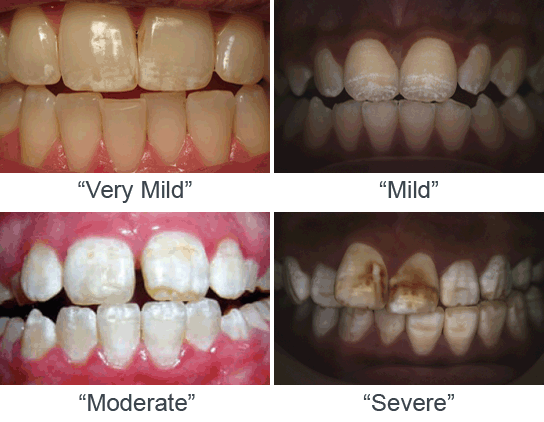
Fluorosis is a defect of tooth enamel caused by too much fluoride intake during the first 8 years of life. Although fluorosis can be cosmetically treated, the damage to the enamel is permanent. Common causes of fluorosis include: fluoridated drinking water (particularly during infancy), ingestion of fluoride toothpaste, use of fluoride tablets, and consumption of processed foods made with fluoridated water.
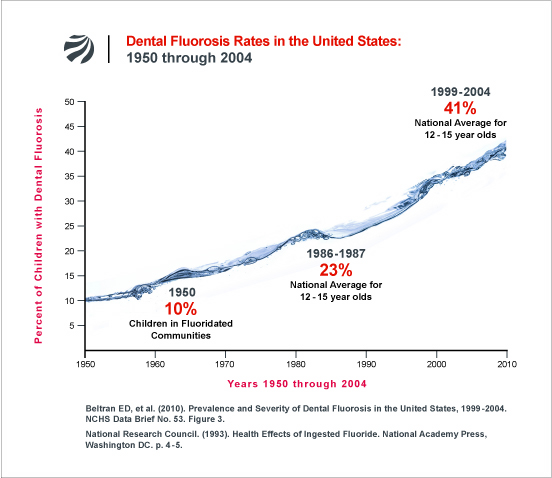
Fluorosis Rates Are on the Rise
Before the widespread use of fluoride in dentistry, dental fluorosis was rarely found in western countries. Today, with virtually every toothpaste now containing fluoride, and most U.S. water supplies containing fluoride chemicals, dental fluorosis rates have reached unprecedented levels. According to the latest national survey by the Centers for Disease Control, 41% of American adolescents now have some form of fluorosis — an increase of over 400% from the rates found 60 years ago. (CDC 2010)
What Is Fluorosis?
Dental fluorosis is a defect of the teeth marked by increased porosity of the enamel (a condition known as “hypomineralization“). In the “moderate” and severe forms of fluorosis, the enamel’s porosity increases to such an extent that the teeth can begin to erode and crumble. Teeth with moderate and severe fluorosis also have very pronounced staining which can deeply disfigure a child’s smile.
Fluorosis & Self-Esteem
Children with dental fluorosis can suffer significant embarrassment and anxiety over the appearance of their teeth. No matter how much they might brush and floss, the fluorosis stains do not go away. In cases of severe fluorosis, a child may be perceived as having “dirty” or “rotten” teeth, which can cause significant damage to a child’s self esteem and emotional well-being. Even “mild” fluorosis — particularly when present on the front two teeth — can be highly objectionable. Indeed, although fluoride advocates used to downplay the esthetic effect of mild fluorosis, studies since the 1990s have repeatedly found that the general public views such teeth as less pleasing, less attractive, and more likely to cause embarrassment to the affected child than normal, non-fluorosed teeth. It is currently estimated that water fluoridation causes cosmetically objectionable fluorosis in 2 to 12% of the population.
Fluorosis: A Visible Sign of Systemic Toxicity
The cosmetic and psychological effects of fluorosis are significant. Dental fluorosis is not limited, however, to cosmetic concerns. The teeth are not the only tissue in the body that accumulate fluoride (the bones, pineal gland, and arteries accumulate it as well). There is no apparent reason, therefore, why fluoride’s effects on the body will be limited to the teeth. As noted by Dr. Hardy Limeback, “it is illogical to assume that tooth enamel is the only tissue affected by low daily doses of fluoride ingestion.” According to the late Dr. John Colquhoun, “Common sense should tell us that if a poison circulating in a child’s body can damage the tooth-forming cells, then other harm also is likely.”
In one study, for example, a British researcher found that the cells in the pineal gland (a gland that contains calcified deposits that accumulate fluoride) were just as susceptible to fluoride-induced toxicity as the tooth-forming cells. Unlike the teeth, however, the pineal gland cannot be seen by the naked eye. As noted by the researcher, “The safety of the use of fluorides ultimately rests on the assumption that the developing enamel organ is most sensitive to the toxic effects of fluoride. The results from this study suggest that-the pinealocytes may be as susceptible to fluoride as the developing enamel organ.” (Luke 1997).
Resources:
- Pictures: To see more photos of dental fluorosis, click here.
- Personal Stories: To read letters from individuals and families impacted by dental fluorosis, click here.
- Research: To read research on dental fluorosis, including studies documenting the increase in its prevalence and the impact it can have on a child’s self-esteem, click here.
- Diagnosis: To see the diagnostic criteria for “very mild,” “mild,” “moderate,” and “severe” fluorosis, click here.
- Treatment Options: To learn more about the options for cosmetically treating fluorosis, click here.
 Print
Print  PDF
PDF
-
-
The Absurdities of Water Fluoridation
[caption id="attachment_10205" align="alignleft" width="190"] Paul Connett, PhD[/caption] Water fluoridation is a peculiarly American phenomenon. It started at a time when Asbestos lined our pipes, lead was added to gasoline, PCBs filled our transformers and DDT was deemed so "safe and effective" that officials felt no qualms spraying kids in school classrooms
-
Why I am now officially opposed to adding fluoride to drinking water
https://www.youtube.com/watch?v=iF-hKlIgCuM April, 2000 To whom it may concern: Since April of 1999, I have publicly decried the addition of fluoride, especially hydrofluosilicic acid, to drinking water for the purpose of preventing tooth decay. The following summarize my reasons. New evidence for lack of effectiveness of fluoridation in modern times. [caption id="attachment_10211" align="alignleft" width="150"] Dr. Hardy
-
50 Reasons to Oppose Fluoridation
Introduction [caption id="attachment_11821" align="alignleft" width="200"] Dr. Paul Connett[/caption] In Europe, only Ireland (73%), Poland (1%), Serbia (3%), Spain (11%), and the U.K. (11%) fluoridate any of their water. Most developed countries, including Japan and 97% of the western European population, do not consume fluoridated water. In the U.S., about 70% of public water supplies are
Related Articles:
-
-
-
Fluoride & IQ: 76 Studies
Note: See the Updated list of fluoride IQ studies at https://fluoridealert.org/researchers/fluoride-iq-studies/the-fluoride-iq-studies/ • As of July 18, 2022, a total of 85 human studies have investigated the relationship between fluoride and human intelligence. • Of these investigations, 76 studies have reported that elevated fluoride exposure is associated with reduced IQ in humans. • The studies
-
Fluoride's Effect on Fetal Brain
The human placenta does not prevent the passage of fluoride from a pregnant mother's bloodstream to the fetus. As a result, a fetus can be harmed by fluoride ingested pregnancy. Based on research from China, the fetal brain is one of the organs susceptible to fluoride poisoning. As highlighted by the excerpts
-
Fluoride: Developmental Neurotoxicity.
Developmental Neurotoxicity There has been a tremendous amount of research done on the association of exposure to fluoride with developmental neurotoxicity. There are over 60 studies reporting reduced IQ in children and several on the impaired learning/memory in animals. And there are studies which link fluoride to Attention Deficit Hyperactivity Disorder. Teaching
Related Studies:
-
-
-
Email Exchange with FDA re: Fluoride Supplements
Email exchange regarding FDA's reasons for not approving fluoride supplements.
-
Harvard's Statement on Chester Douglass/Scientific Misconduct
Statement Concerning the Outcome of the Review into Allegations of Research Misconduct Involving Fluoride Research BOSTON-August 15, 2006-The Harvard Medical School and School of Dental Medicine (HSDM) review of Chester Douglass, DMD, PhD, professor of oral health policy and epidemiology at HSDM, has concluded that Douglass did not intentionally omit, misrepresent,
-
The 'Altered Recommendations' of the 1983 Surgeon General's Panel
"We believe that EPA staff and managers should be called to testify, along with members of the 1983 Surgeon Generals panel and officials of the Department of Human Services, to explain how the original recommendations of the Surgeon Generals panel were altered to allow EPA to set otherwise unjustifiable drinking water standards for fluoride."
Related Miscellaneous Content:
-