
Compiled by Michael F. Dolan, PhD
Water Fluoride Associated With Lower Nonverbal Reasoning, Spatial Processing in USA

A study of 2,500 children from 17 sites in the USA has found that home water fluoride levels of 1.1 milligrams per liter show a significant association with reduced fluid cognition, meaning nonverbal reasoning and spatial processing, and that the association starts to appear at the 0.7 milligram per liter of fluoride deliberately added to drinking water supplies.
Writing in the American Journal of Epidemiology, researchers from Columbia University, other New York institutions and universities around the USA report that their analysis of the Environmental influences on Child Health Outcomes (ECHO) Cohort, and fluoride levels estimated from residential addresses, census data, and municipal water quality reports found an inverse association between fluoride level and childhood intelligence.
They report, “These findings suggest that at concentrations below both the current WHO guideline (1,500 µg/L) and the current USEPA MCL (4,000 µg/L), prenatal public water fluoride exposure is inversely associated with child fluid cognition in the US. Taken together with conclusions from the [National Toxicology Program] report, our findings suggest that downward revision of the USEPA MCL [maximum contaminant level] may be warranted.”
They note that over 2.9 million U.S. residents receive public water with fluoride concentrations exceeding 1,500 micrograms/L while 20.5 million residents receive water with more than 700 micrograms per liter.
The authors see their results as further completing understanding of the neurotoxic effect of low-level fluoride exposure.
They write, “Consistent with our findings, prior studies of prenatal fluoride measured via maternal urine have reported associations with cognition that are primarily driven by performance IQ, which closely corresponds to fluid cognition. Fluid cognition reflects the capacity for new learning and information processing and is more influenced by neurobiological processes than by learning experiences.”
They conclude, “The effects of prenatal fluoride on cognition may appear larger in magnitude when ascertained in younger children because early childhood is a period of rapid neurodevelopment, during which the downstream effects of prenatal exposure may be more readily detectable. When the outcome is ascertained in older children, however, cumulative postnatal experiences (e.g., schooling and other educational experiences) may partially buffer earlier effects, resulting in smaller but still detectable associations.”
Source: https://jamanetwork.com/journals/jamanetworkopen/fullarticle/2853622
Washington State Petition Would Require Notice on Prenatal Fluoride Exposure

Dentist, longtime organizer, and FAN board member Dr. Bill Osmunson and the group Washington Action for Safe Water have petitioned the State Board of Health Rules Committee to adopt a rule that would require water systems to notify consumers of their options to avoid prenatal fluoride exposure.
In the petition, filed August 20th, Osmunson asks the Board to adopt a new rule, “requiring public water systems whose fluoride concentration – from any source, including intentional fluoridation and naturally occurring background fluoride – equals or exceeds 0.2 milligrams per liter (mg/L) to provide a specified advisory notice to consumers regarding prenatal fluoride exposure.”
The proposed advisory reads in part, “This water system’s fluoride concentration is at or above 0.2 milligrams per liter. Pregnant people may wish to consider alternative water sources, such as bottled spring or purified water, or water treated by reverse osmosis or distillation, during pregnancy.”
Dr. Osmunson argues that there is no prenatal benefit to fluoride exposure, so a standard that is based on protection should be adopted for pregnancies, writing, “Washington’s 0.7 mg/L fluoridation target has always been a benefit-risk balance, calculated against childhood dental caries prevention. That balance does not apply to a population for which no benefit has been demonstrated. Where no population-specific benefit has been demonstrated and credible evidence of potential harm exists, the regulatory question shifts toward protection and informed choice rather than optimization of a benefit-risk balance.”
Source: https://sboh.wa.gov/sites/default/files/2026-09/Tab10c-Petition43-Oct26.pdf
Fluoride Exposure Associated With Reduced Size of Thyroid Gland
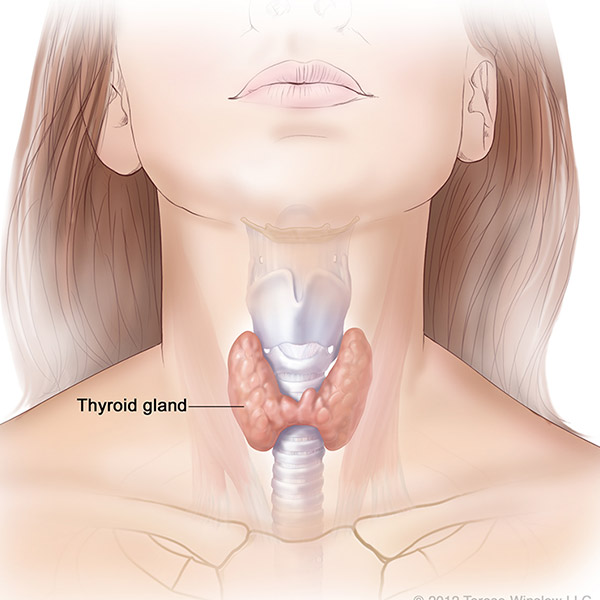
A cross-sectional study of a population of over 750 school children with adequate iodine intake in Tianjin, China found that both dental fluorosis and urinary fluoride were associated with reduced thyroid volume, as measured by ultrasound.
In an article published September 15th in Environmental Health, the authors from the Tianjin Centers for Disease Control and Prevention also report that urinary fluoride was associated with lower free thyroxine (FT4), a thyroid hormone, at fluoride levels near 1.0 and 2.0 milligrams per liter.
The authors note, “In recent years, the effect of fluoride exposure on thyroid function has received increasing attention. As a key endocrine organ, the thyroid directly influences childhood growth, metabolism, and neurological development.”
The scientists also found fluoride exposure as indicated by dental fluorosis and urinary fluoride levels was associated with a reduced risk of goiter.
The authors conclude, “This study shows that fluoride exposure is associated with altered thyroid morphology and function in children. In iodine-adequate areas, fluoride exposure was associated with reduced thyroid volume, lower goiter risk, lower FT4, reduced risk of elevated TSH [thyroid stimulating hormone], and increased risk of low FT3 [free triiodothyronine] in Chinese school-aged children. This association should not be misinterpreted as protective. The reduction in thyroid volume with decreased FT4 more likely reflects tissue atrophy and reduced functional reserve, not healthy status. Complex dose-response relationships exist between urinary fluoride and thyroid indicators. Environmental fluoride exposure is a non-negligible factor affecting children’s thyroid health, with more complex effects than previously recognized.”
Source: https://doi.org/10.1186/s12940-026-01337-0
Animal Studies Associate Fluoride Exposure With Reduction in Concentrations of Needed Metal Nutrients and Increase in the Concentrations of Toxic Metals
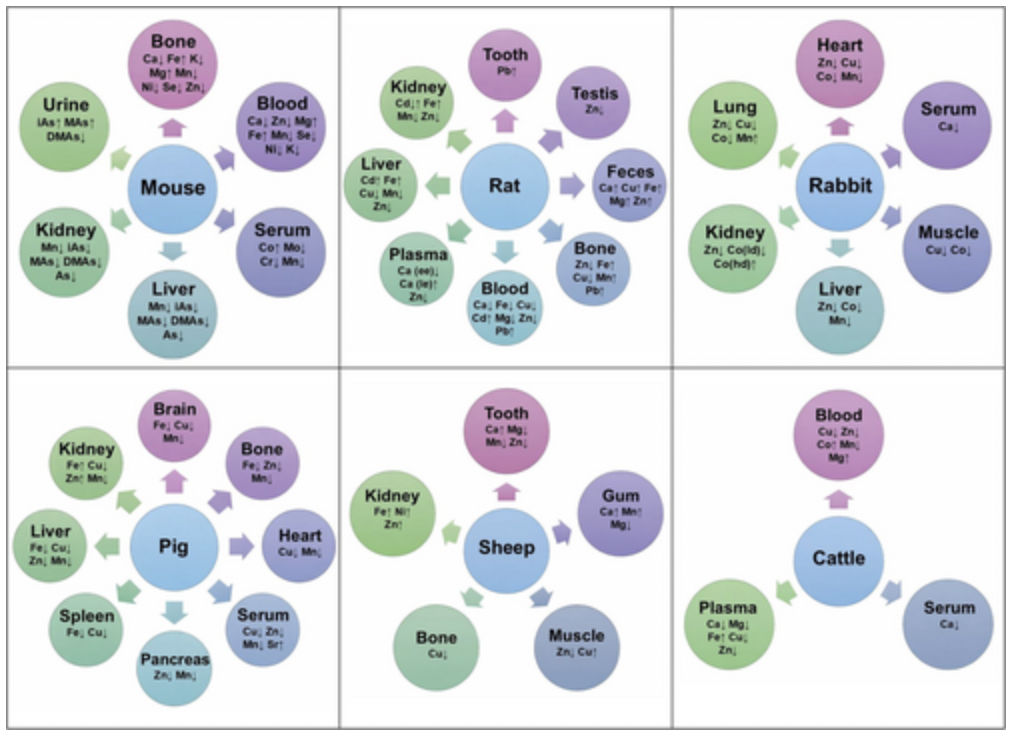
A open access systematic review of the science of fluoride’s interactions with the “metallome,” the collection of metal elements and metal-containing biomolecules in the body, has found a decrease in beneficial metals and an increase in harmful ones. As the authors note, “Essential elements were predominantly depleted, most consistently zinc, copper and manganese, whereas the toxic metals lead and cadmium tended to be retained.”
The authors, Brazilian dental researchers writing in Basic & Clinical Pharmacology & Toxicology, reported, “Across four decades of preclinical studies, fluoride exposure was repeatedly associated with element- specific changes of both essential and toxic elements among bone, soft tissues and circulating compartments, with the direction and magnitude of these changes depending on the element, the dose and duration of exposure, and the experimental context. These patterns… support the interpretation of fluoride as a systemic modifier of the metallome organization.”
Regarding calcium (Ca), they found “Across the included studies, fluoride was associated chiefly with a redistribution of calcium between mineralized and circulating compartments, with reductions in circulating Ca being the most consistent finding.”
For zinc copper and manganese, they wrote, “These transition metals, grouped because they responded similarly across studies, showed predominantly reductions in soft and mineralized tissues, with manganese occasionally increasing in bone.”
In contrast to these conclusions, the authors found toxic metals accumulate in the body to a greater extent with fluoride co-exposure.
Regarding lead, they write, “Lead [Pb] displayed the clearest and most consistent pattern: fluoride co- exposure increased Pb accumulation in calcified tissues, without evidence of compensatory redistribution. When dental tissues were evaluated, the effects became even more pronounced in contexts of co- exposure to toxic metals. In Wistar rats exposed to Pb with or without fluoride, the presence of fluoride was associated with a marked increase in Pb concentrations in enamel, dentin and bone, indicating that mineralized tissues concentrate higher amounts of Pb (3× more Pb in the co- exposure group when compared with the group exposed to Pb alone).”
Despite the systematic scope of their report, the authors downplay the importance of their findings, writing, “From a translational perspective, current preclinical evidence should not be interpreted as definitive proof of toxic synergy but rather as an indication that fluoride exposure may act as a modifier of metal homeostasis under specific experimental conditions.”
Source: https://doi.org/10.1111/bcpt.70295
Dentist Advises Endurance Athletes to Drink Non-Fluoridated Water
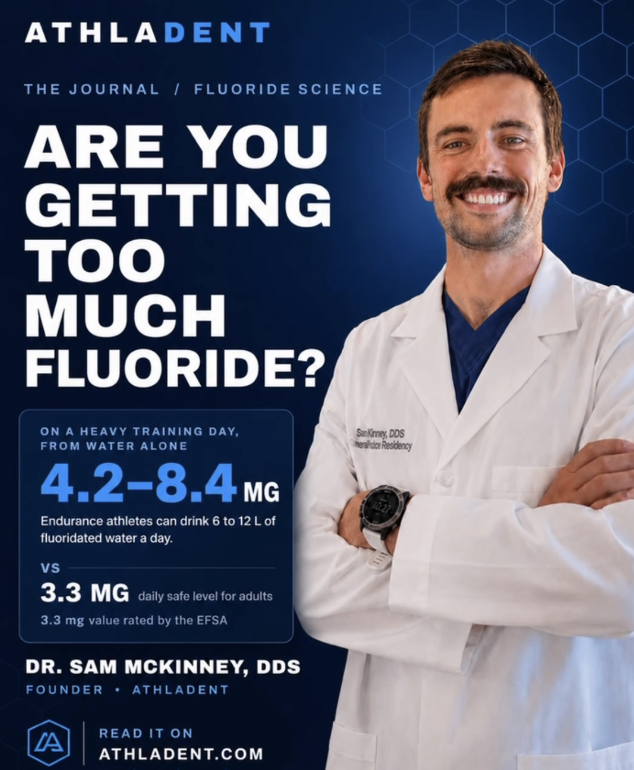
In a posting on the internet entitled, “Athletes and Fluoride: A Concern for Endurance Athletes,” the Wisconsin dentist Sam McKinney has acknowledged that some athletes drink large amounts of water, and recommended they drink non-fluoridated water to avoid the adverse effects of the toxin.
While McKinney continues to endorse water fluoridation, a public policy in which 0.7 milligrams (mg) per liter is added to drinking water to reduce tooth decay, he acknowledges that endurance athletes drink many more times the two liters of water per day expected of the general public.
“On a hot day with long training, an endurance athlete’s total daily water intake can reach 6 to 12 liters or more. At 0.7 parts per million (ppm), that comes to 4.2 to 8.4 mg of fluoride from drinking water alone. That already passes the European Food Safety Authority (EFSA) safe level of 3.3 mg/day and approaches or exceeds the 1997 Institute of Medicine limit of 10 mg/day,” writes McKinney.
The dentist also noted that, “exercise appears to slow how quickly the body clears fluoride.”
He writes, “The problem is compounded by how the body handles fluoride during exercise, because exertion does not raise fluoride excretion in proportion to intake. A pilot study found that moderate and vigorous exercise raised plasma fluoride and pointed toward reduced renal fluoride clearance (13.1 mL/min during moderate exercise versus 26.5 mL/min at rest). A follow-up crossover study confirmed that moderate exercise significantly raised peak plasma fluoride (226 ng/mL versus 27 ng/mL at rest). In other words, even though athletes drink more and produce more urine, the body does not excrete the extra fluoride at the same rate. It is retained, and it stays available to produce biological effects.”
McKinney acknowledges that the goal in controlling fluoride exposure is “to protect against effects on the developing brain, thyroid function, and bone mineralization,” rare admissions from a dentist writing about water fluoridation.
His “dentist’s starting protocol” for endurance athletes includes using fluoridated toothpaste twice a day, spitting, but not rinsing the fluoride from the teeth, drinking “filtered, non-fluoridated water during training and throughout the day,” and, as an option, using nanohydroxyapatite toothpaste before carbohydrate-heavy sessions “to add enamel protection without adding to your fluoride load.”
Source: https://athladent.com/blogs/news/fluoride-are-you-taking-too-much
•• Michael Dolan can be contacted at <mdolan.ecsn@outlook.com>