
Research Studies
Study Tracker
Salidroside Alleviates Fluoride-Induced Pyroptosis and Developmental Neurotoxicity Through P2X7R/NF-kB/NLRP3 Pathway.Abstract
Original abstract online at
https://link.springer.com/article/10.1007/s12011-025-04852-2
Article updated as of 12 September 2026
Highlights
• Fluoride exposure induces striatal neuronal pyroptosis and neurobehavioral deficits in offspring rats.
• Fluoride-induced neuronal pyroptosis is correlated with P2X7R/NF-kB/NLRP3 pathway.
• Salidroside mitigates fluoride-induced neuronal pyroptosis by inhibiting the P2X7R/NF-kB/NLRP3 pathway.
Fluoride can cause damage to neurons, but the specific mechanisms remain unclear. Neuronal pyroptosis is associated with cognitive dysfunction, but previous studies mainly focused on hippocampal impairments. This study aimed to whether the P2X7R/NF-kB/NLRP3 pathway would trigger pyroptosis in striatal neurons, thereby mediating neurotoxicity of fluoride, and to evaluate the therapeutic potential of salidroside (Sal). Sal, a key bioactive compound derived from Rhodiola rosea, has been reported that it mainly reduces cell pyroptosis by inhibiting the P2X7R/NF-kB/NLRP3 regulatory axis, thereby improving the neurological function in the brain injury models. Therefore, this study explored, this study investigated its potential protective effects against fluoride-induced neurotoxicity. Therefore, an in vivo model of the second-generation (F2) SD rats and an in vitro model of NG108-15 cells exposed to fluoride with Sal intervention were established. The radial arm maze (RAM) was used to measure neurobehavioral changes. Hematoxylin–Eosin (HE) and transmission electron microscopy (TEM) were used to observe histopathological and ultrastructural changes in the striatum of F2 rats. Cell viability and the expressions of pyroptosis-related proteins were measured using biochemical methods. HE staining demonstrated striatal neuronal degeneration in fluoride-exposed groups, the RAM test indicated neurobehavioral defects, and TEM identified ultrastructural neuronal damage. Fluoride activated the P2X7R/NF-kB/NLRP3 pathway, promoting pyroptosis and impairing the memory ability in F2 rats. Mechanistically, Sal mitigated fluoride-induced neuronal loss by blocking P2X7R/NF-kB/NLRP3 signaling and pyroptotic cell death. In summary, these findings suggest the P2X7R/NF-kB/NLRP3 axis mediates fluoride-induced striatal pyroptosis and neurotoxicity, positioning salidroside as a promising therapeutic candidate.
Graphical Abstract
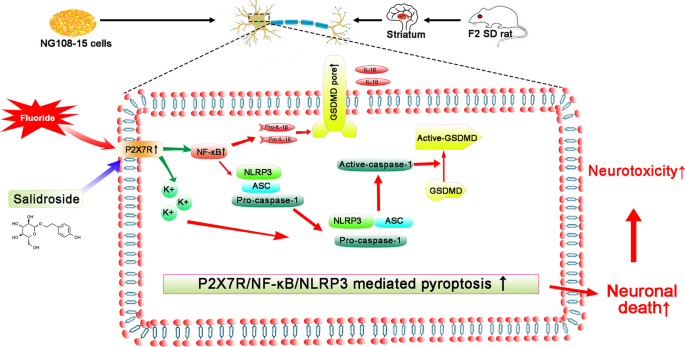
A proposed model for the role of pyroptosis in fluoride neurotoxicity and neuroprotective effect of Sal. P2X7R/NF-kB/NLRP3 pathway conducted pyroptosis plays a vital role in fluoride neurotoxicity. Specifically, inhibiting P2X7R/NF-kB/NLRP3 pathway by the Sal alleviated fluoride-induced pyroptosis, prevented the resultant apoptosis, and promoted neuronal survival
Data Availability
No datasets were generated or analysed during the current study.
Change history
12 September 2026: The original version of this article was updated. In the sentence, “Notably, Sal inhibits the P2X7R/NF-kB/NLRP3 regulatory axis, thereby reducing pyroptosis and improving neurological function in brain injury models [35],” the reference citation [35] should be changed to [37]. In the sentence, “Based on prior 50% inhibitory concentration (IC50) data (80 mg/L NaF) [2], NG108-15 cells at 70%–80% confluency were treated with NaF at 0, 20 (1/4 IC50), 40 (1/2 IC50), and 80 mg/L (IC50) for 24 h,” the reference citation [2] should be changed to [42].
Abbreviations
- CCK-8 :
- Cell Counting Kit-8
- Caspase-1 :
- Cysteinyl aspartate specific proteinase 1
- SD :
- Standard deviation
- GAPDH :
- Glyceraldehyde-3-phosphate dehydrogenase
- NF-xB :
- Nuclear factor kappa B
- IL-1B :
- Interleukin 1 beta
- NLRs :
- NOD-like receptors
References
-
Saeed M, Malik RN, Kamal A (2020) Fluorosis and cognitive development among children (6–14 years of age) in the endemic areas of the world: a review and critical analysis. Environ Sci Pollut Res Int 27(3):2566–2579
-
Ting C, Guohui B, Yuan T, Yu G (2022) Research progress on the effects of various macro and trace elements on fluorosis. Chin J Endemiol 41(3):253–258
-
Dall Agnol MA, Battiston C, Tenuta LMA, Cury JA (2022) Fluoride formed on enamel by fluoride varnish or gel application: a randomized controlled clinical trial. Caries Res 56(1):73–80
-
Li X, Yang J, Liang C, Yang W, Zhu Q, Luo H, Liu X, Wang J, Zhang J (2022) Potential protective effect of riboflavin against pathological changes in the main organs of male mice induced by fluoride exposure. Biol Trace Elem Res 200(3):1262–1273
-
Hui L, Lijun Z, Peng L, Jun Y, Jie H, Junrui P, Dianjun S (2022) Achievement in prevention and control of endemic diseases in China in the past 10 years (2012–2021), challenges in the future and countermeasures. Chin J Endemiol 41(9):689–694
-
Grandjean P (2019) Developmental fluoride neurotoxicity: an updated review. Environ Health 18(1):110
-
Liang C, He Y, Liu Y, Gao Y, Han Y, Li X, Zhao Y, Wang J, Zhang J (2020) Fluoride exposure alters the ultra-structure of sperm flagellum via reducing key protein expressions in testis. Chemosphere 246:125772
-
Lu F, Lan Z, Xin Z, He C, Guo Z, Xia X, Hu T (2020) Emerging insights into molecular mechanisms underlying pyroptosis and functions of inflammasomes in diseases. J Cell Physiol 235(4):3207–3221
-
Swanson KV, Deng M, Ting JP (2019) The NLRP3 inflammasome: molecular activation and regulation to therapeutics. Nat Rev Immunol 19(8):477–489
-
Li S, Sun Y, Song M, Song Y, Fang Y, Zhang Q, Li X, Song N, Ding J, Lu M, Hu G (2021) Nlrp3/caspase-1/GSDMD-mediated pyroptosis exerts a crucial role in astrocyte pathological injury in mouse model of depression. JCI Insight. https://doi.org/10.1172/jci.insight.146852
-
Paldino E, D’Angelo V, Sancesario G, Fusco FR (2020) Pyroptotic cell death in the R6/2 mouse model of Huntington’s disease: new insight on the inflammasome. Cell Death Discov 6:69
-
Poh L, Fann DY, Wong P, Lim HM, Foo SL, Kang S, Rajeev V, Selvaraji S, Iyer VR, Parathy N, Khan MB, Hess DC, Jo D, Drummond GR, Sobey CG, Lai MKP, Chen CL, Lim LHK, Arumugam TV (2021) AIM2 inflammasome mediates hallmark neuropathological alterations and cognitive impairment in a mouse model of vascular dementia. Mol Psychiatry 26(8):4544–4560
-
Wang S, Yuan Y, Chen N, Wang H (2019) The mechanisms of NLRP3 inflammasome/pyroptosis activation and their role in Parkinson’s disease. Int Immunopharmacol 67:458–464
-
Zhao N, Sun C, Zheng M, Liu S, Shi R (2019) Amentoflavone suppresses amyloid beta1-42 neurotoxicity in Alzheimer’s disease through the inhibition of pyroptosis. Life Sci 239:117043
-
Zhang Q, Li T, Shi R, Qi R, Hao X, Ma B (2024) Fluoride promotes the secretion of inflammatory factors in microglia through NLRP3/caspase-1/GSDMD pathway. Environ Sci Pollut Res Int 31(13):19844–19855
-
Zhang J, Tang Y, Hu Z, Xu W, Ma Y, Xu P, Xing H, Niu Q (2023) The inhibition of TRPML1/TFEB leads to lysosomal biogenesis disorder, contributes to developmental fluoride neurotoxicity. Ecotoxicol Environ Saf 250:114511
-
Andrejew R, Oliveira-Giacomelli A, Ribeiro DE, Glaser T, Arnaud-Sampaio VF, Lameu C, Ulrich H (2020) The P2X7 receptor: central hub of brain diseases. Front Mol Neurosci 13:124
-
Glaser T, Andrejew R, Oliveira-Giacomelli A, Ribeiro DE, Bonfim Marques L, Ye Q, Ren W, Semyanov A, Illes P, Tang Y, Ulrich H (2020) Purinergic receptors in basal ganglia diseases: shared molecular mechanisms between Huntington’s and Parkinson’s disease. Neurosci Bull 36(11):1299–1314
-
Olla I, Santos-Galindo M, Elorza A, Lucas JJ (2020) P2X7 receptor upregulation in Huntington’s disease brains. Front Mol Neurosci 13:567430
-
Li Y, Xia Y, Yin S, Wan F, Hu J, Kou L, Sun Y, Wu J, Zhou Q, Huang J, Xiong N, Wang T (2021) Targeting microglial alpha-synuclein/TLRs/NF-kappaB/NLRP3 inflammasome axis in Parkinson’s disease. Front Immunol 12:719807
-
Mitchell JP, Carmody RJ (2018) NF-kappaB and the transcriptional control of inflammation. Int Rev Cell Mol Biol 335:41–84
-
Wang Y, Gao X, Tang Y, Yu Y, Sun M, Chen F, Li Y (2022) The role of NF-kappaB/NLRP3 inflammasome signaling pathway in attenuating pyroptosis by melatonin upon spinal nerve ligation models. Neurochem Res 47(2):335–346
-
Mangan MSJ, Olhava EJ, Roush WR, Seidel HM, Glick GD, Latz E (2018) Targeting the NLRP3 inflammasome in inflammatory diseases. Nat Rev Drug Discov 17(8):588–606
-
Guan F, Jiang W, Bai Y, Hou X, Jiang C, Zhang C, Jacques ML, Liu W, Lei J (2021) Purinergic P2X7 receptor mediates the elimination of Trichinella spiralis by activating NF-kappaB/NLRP3/IL-1beta pathway in macrophages. Infect Immun 89(5)
-
Li Z, Huang Z, Zhang H, Lu J, Tian Y, Wei Y, Yang Y, Bai L (2021) P2X7 receptor induces pyroptotic inflammation and cartilage degradation in osteoarthritis via NF-kappaB/NLRP3 crosstalk. Oxid Med Cell Longev 2021:8868361
-
Yoshida K, Okamura H, Hiroshima Y, Abe K, Kido J, Shinohara Y, Ozaki K (2017) PKR induces the expression of NLRP3 by regulating the NF-kappaB pathway in Porphyromonas gingivalis-infected osteoblasts. Exp Cell Res 354(1):57–64
-
Zhang Q, Hu F, Guo F, Zhou Q, Xiang H, Shang D (2019) Emodin attenuates adenosine triphosphate-induced pancreatic ductal cell injury in vitro via the inhibition of the P2X7/NLRP3 signaling pathway. Oncol Rep 42(4):1589–1597
-
Ball DP, Taabazuing CY, Griswold AR, Orth EL, Rao SD, Kotliar IB, Vostal LE, Johnson DC, Bachovchin DA (2020) Caspase-1 interdomain linker cleavage is required for pyroptosis. Life Sci Alliance. https://doi.org/10.26508/lsa.202000664
-
Kong H, Zhao H, Chen T, Song Y, Cui Y (2022) Targeted P2X7/NLRP3 signaling pathway against inflammation, apoptosis, and pyroptosis of retinal endothelial cells in diabetic retinopathy. Cell Death Dis 13(4):336
-
Poh L, Sim WL, Jo D, Dinh QN, Drummond GR, Sobey CG, Chen CL, Lai MKP, Fann DY, Arumugam TV (2022) The role of inflammasomes in vascular cognitive impairment. Mol Neurodegener 17(1):4
-
Yang Y, Wang H, Kouadir M, Song H, Shi F (2019) Recent advances in the mechanisms of NLRP3 inflammasome activation and its inhibitors. Cell Death Dis 10(2):128
-
Yuan B, Zhou X, You Z, Xu W, Fan J, Chen S, Han Y, Wu Q, Zhang X (2020) Inhibition of AIM2 inflammasome activation alleviates GSDMD-induced pyroptosis in early brain injury after subarachnoid haemorrhage. Cell Death Dis 11(1):76
-
Zhang Z, Gu X, Zhao X, He X, Shi H, Zhang K, Zhang Y, Su Y, Zhu J, Li Z, Li G (2021) Nlrp3 ablation enhances tolerance in heat stroke pathology by inhibiting IL-1beta-mediated neuroinflammation. J Neuroinflammation 18(1):128
-
Yildiz MO, Celik H, Caglayan C, Kandemir FM, Gur C, Bayav I, Genc A, Kandemir O (2022) Neuromodulatory effects of hesperidin against sodium fluoride-induced neurotoxicity in rats: involvement of neuroinflammation, endoplasmic reticulum stress, apoptosis and autophagy. Neurotoxicology 90:197–204
-
Chai Y, Cai Y, Fu Y, Wang Y, Zhang Y, Zhang X, Zhu L, Miao M, Yan T (2022) Salidroside ameliorates depression by suppressing NLRP3-mediated pyroptosis via P2X7/NF-kappaB/NLRP3 signaling pathway. Front Pharmacol 13:812362
-
Gao Z, Zhan H, Zong W, Sun M, Linghu L, Wang G, Meng F, Chen M (2023) Salidroside alleviates acetaminophen-induced hepatotoxicity via Sirt1-mediated activation of Akt/Nrf2 pathway and suppression of NF-kappaB/NLRP3 inflammasome axis. Life Sci 327:121793
-
Jin M, Wang C, Xu Y, Zhang Z, Wu X, Ye R, Zhang Q, Han D (2022) Pharmacological effects of salidroside on central nervous system diseases. Biomed Pharmacother 156:113746
-
Niu L, Xu M, Liu W, Yu H, Yu S, Li F, Wang T, Sun D, Yao T, Li W, Yang Z, Liu X, Zuo Z (2024) The GLCCI1/STAT3 pathway: a novel pathway involved in diabetic cognitive dysfunction and the therapeutic effect of salidroside. J Mol Histol 55(5):851–861
-
Shen J, Chen S, Li X, Wu L, Mao X, Jiang J, Zhu D (2024) Salidroside mediated the Nrf2/GPX4 pathway to attenuates ferroptosis in Parkinson’s disease. Neurochem Res 49(5):1291–1305
-
Zhang X, Xie L, Long J, Xie Q, Zheng Y, Liu K, Li X (2021) Salidroside: a review of its recent advances in synthetic pathways and pharmacological properties. Chem Biol Interact 339:109268
-
Zheng J, Zhang J, Han J, Zhao Z, Lin K (2024) The effect of salidroside in promoting endogenous neural regeneration after cerebral ischemia/reperfusion involves notch signaling pathway and neurotrophic factors. BMC Complement Med Ther 24(1):293
-
Peng Z, Yang X, Zhang H, Yin M, Luo Y, Xie C (2021) Mir-29b-3p aggravates NG108-15 cell apoptosis triggered by fluorine combined with aluminum. Ecotoxicol Environ Saf 224:112658
-
Zhang C, Huo S, Fan Y, Gao Y, Yang Y, Sun D (2020) Autophagy may be involved in fluoride-induced learning impairment in rats. Biol Trace Elem Res 193(2):502–507
-
Wu J, Wang W, Liu Y, Sun J, Ye Y, Li B, Liu X, Liu H, Sun Z, Li M, Cui J, Sun D, Yang Y, Gao Y (2015) Modifying role of GSTP1 polymorphism on the association between tea fluoride exposure and the brick-tea type fluorosis. PLoS ONE 10(6):e0128280
-
Singh N, Verma KG, Verma P, Sidhu GK, Sachdeva S (2014) A comparative study of fluoride ingestion levels, serum thyroid hormone & TSH level derangements, dental fluorosis status among school children from endemic and non-endemic fluorosis areas. Springerplus 3:7
-
Shen J, Xu J, Wen Y, Tang Z, Li J, Sun J (2024) Carnosine ameliorates postoperative cognitive dysfunction of aged rats by limiting astrocytes pyroptosis. Neurotherapeutics 21(4):e00359
-
Kelley N, Jeltema D, Duan Y, He Y (2019) The NLRP3 inflammasome: an overview of mechanisms of activation and regulation. Int J Mol Sci. https://doi.org/10.3390/ijms20133328
-
Rutsch A, Kantsjo JB, Ronchi F (2020) The gut-brain axis: how microbiota and host inflammasome influence brain physiology and pathology. Front Immunol 11:604179
-
Hao W, Hao C, Wu C, Xu Y, Jin C (2022) Aluminum induced intestinal dysfunction via mechanical, immune, chemical and biological barriers. Chemosphere 288(Pt 2):132556
-
Hao W, Hao C, Wu C, Xu Y, Wu S, Lu X, Yang J, Jin C (2021) Aluminum impairs cognitive function by activating DDX3X-NLRP3-mediated pyroptosis signaling pathway. Food Chem Toxicol 157:112591
-
Hao W, Zhu X, Liu Z, Song Y, Wu S, Lu X, Yang J, Jin C (2023) Aluminum exposure induces central nervous system impairment via activating NLRP3-medicated pyroptosis pathway. Ecotoxicol Environ Saf 264:115401
-
Wu Q, Shan X, Li X, Guan J, Song F, Zhou X, Fan Y, Guo L (2025) Salidroside ameliorates neuroinflammation in autistic rats by inhibiting NLRP3/caspase-1/GSDMD signal pathway. Brain Res Bull 220:111132
-
Xiao L, Li L, Huang J, Luan Y, Pan J, Gai Y, Xu Z (2023) Salidroside attenuates lipopolysaccharide-induced neuroinflammation and cognitive impairment in septic encephalopathy mice. Int Immunopharmacol 117:109975
-
Yu S, Xu H, Chi X, Wei L, Cheng Q, Yang Y, Zhou C, Ding F (2018) 2-(4-Methoxyphenyl)ethyl-2-acetamido-2-deoxy-beta-d-pyranoside (a salidroside analog) confers neuroprotection with a wide therapeutic window by regulating local glucose metabolism in a rat model of cerebral ischemic injury. Neuroscience 391:60–72
-
Chen X, Wei J, Wang H, Peng Y, Tang C, Ding Y, Li S, Long Z, Lu X, Wang Y (2023) Effects and mechanisms of salidroside on the behavior of SPS-induced PTSD rats. Neuropharmacology 240:109728
-
Lu S, Ji N, Wang W, Lin X, Gao D, Geng D (2024) Salidroside improves cognitive function in Parkinson’s disease via Braf-mediated mitogen-activated protein kinase signaling pathway. Biomed Pharmacother 177:116968
-
Cai Y, Chai Y, Fu Y, Wang Y, Zhang Y, Zhang X, Zhu L, Miao M, Yan T (2021) Salidroside ameliorates Alzheimer’s disease by targeting NLRP3 inflammasome-mediated pyroptosis. Front Aging Neurosci 13:809433
-
Ward R, Li W, Abdul Y, Jackson L, Dong G, Jamil S, Filosa J, Fagan SC, Ergul A (2019) Nlrp3 inflammasome inhibition with MCC950 improves diabetes-mediated cognitive impairment and vasoneuronal remodeling after ischemia. Pharmacol Res 142:237–250
-
Liu J, Ma W, Zang C, Wang G, Zhang S, Wu H, Zhu K, Xiang X, Li C, Liu K, Guo J, Li L (2021) Salidroside inhibits NLRP3 inflammasome activation and apoptosis in microglia induced by cerebral ischemia/reperfusion injury by inhibiting the TLR4/NF-kappaB signaling pathway. Ann Transl Med 9(22):1694
Funding
Funding for this project was provided by the National Key R&D Program of China (2022YFC2503002) and Guizhou Provincial Basic Research Program (Natural Science) (No. ZK[2024] 122).
Ethics declarations
Competing interests
The authors declare no competing interests.