
Pregnant mothers exposed to drinking water fluoride levels near current U.S. recommended levels (.7ppm) tended to have children who scored lower on tests of fluid reasoning as fluoride levels increased, according to a new study supported by the NIH’s Environmental Influences on Child Health Outcomes (ECHO) Program.
The finding is significant and may effect how fluoridation policy is viewed in the United States, the most heavily fluoridated nation in the world.
Staunch advocates of water fluoridation, including the American Dental Association, have long claimed that studies showing IQ/cognition loss from fluoride are due to levels of exposure “orders of magnitude above optimal levels”. This new study turns that assertion on its head – showing lowered cognition at fluoride levels that U.S. residents are routinely exposed to (.7ppm).
“This study addresses an important gap by evaluating prenatal water fluoride and child cognition in a large U.S. sample,” said lead author Katrina Simon, PhD, of Columbia University Mailman School of Public Health. “Findings from this work offer evidence that can inform ongoing guidance aimed at supporting children’s development.”
The study followed 2,500 kids across 23 states, led by a multi-center team of scientists, and found that fluoride in public drinking water during pregnancy is linked to lower cognition scores in children —even at levels considered “optimal” for dental health.
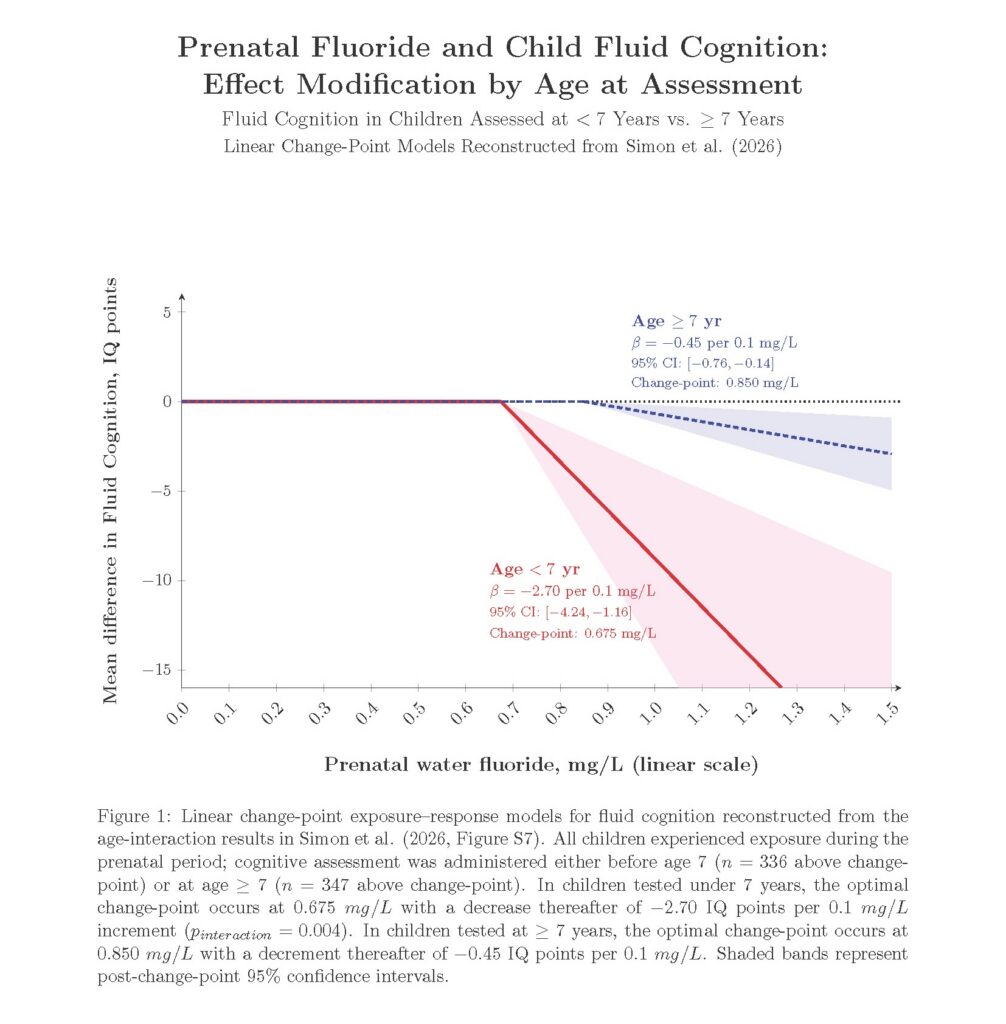
The interaction plot above shows how important age at IQ testing is, with testing at younger ages showing a much larger adverse effect of F on IQ than testing at older ages. This is very consistent with other studies that have IQ tests administered at ages 16 or older and which usually find “no effect”. There are good explanations for why IQ loss becomes harder to detect as children get older and into adolescence and young adulthood.
ECHO researchers published a press release on the study and noted that “future research could focus on when children may be most sensitive to fluoride exposure and examine both potential developmental risks and dental health benefits to better understand relationships between fluoride exposure and child health.”
Because our study used fluoride measurements from public water systems that are collected as part of routine drinking water monitoring, the findings may help inform future evaluations of public drinking water guidelines,” said co-senior author Anne Nigra, PhD, also of Columbia University Mailman School of Public Health.
NOTE: Fluoridation advocates will likely claim this study shows a “safe threshold” of fluoride up through about .7ppm. That would be an incorrect understanding of the results of the study and its implications, especially for risk assessment. The Simon study shows not that there is no margin of safety for artificial fluoridation. A “safe threshold” only addresses average sensitivity and average intake. People who consume more than an average amount of water and people who are more sensitive to chemical exposures will have adverse effects at not just 10x lower fluoride concentrations, but potentially at 100x lower concentrations than “optimal”.